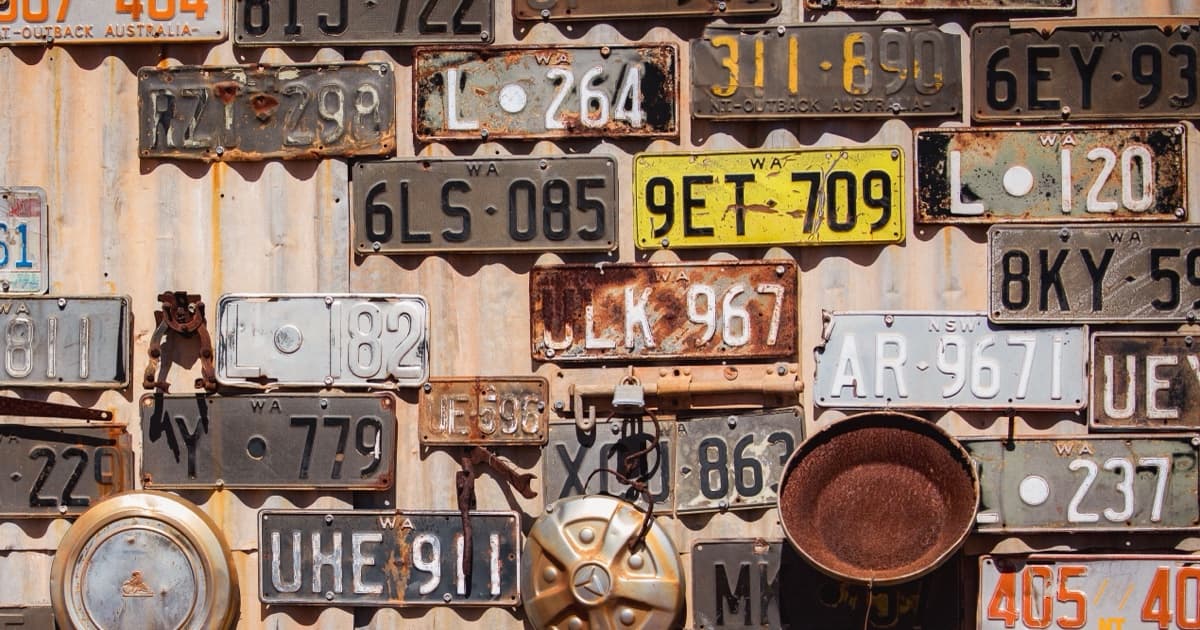
Number Plates as Art: The Design Story Behind Australia's Most Overlooked Canvas

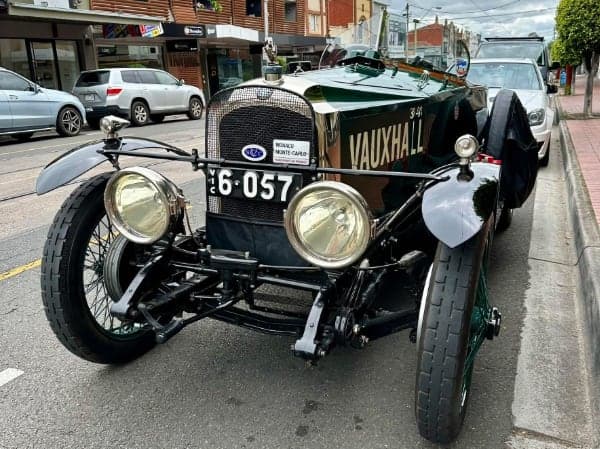
You probably don’t think of the rectangle bolted to your bumper as a piece of design. But consider it for a moment: it has a colour palette, a typeface, a material finish, and a layout — all chosen deliberately, all telling a story. Australian number plates have been quietly evolving as design objects since 1910, reflecting everything from state identity and manufacturing technology to cultural pride and personal expression.
This is the design story most people drive past every day.
The Enamel Era: 1910–1930s
Australia’s earliest plates were genuinely handmade. When vehicle registration became compulsory from 1910, each state began issuing plates starting from the number 1, manufactured in vitreous enamel — the same technique used for vintage advertising signs and railway signage.
These early plates were strikingly minimal: white numerals on a black background, no state prefix, no slogan, no decoration. Just a number. The enamel process involved fusing powdered glass to steel at extremely high temperatures, producing a surface with a deep, glossy lustre that has proven remarkably durable — plates from this era still survive in collections today, their colours barely faded after more than a century.
There’s something almost Bauhaus about these early designs. Before branding, before slogans, before the modern obsession with personalisation, these plates communicated a single idea with total clarity. The design was the function.
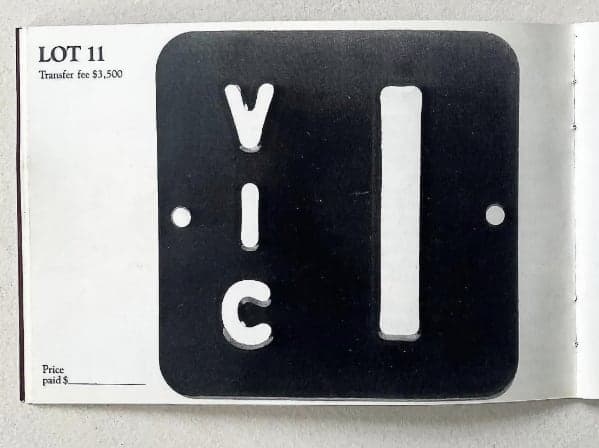
In Victoria, the very first plates became objects of power before they became objects of desire. The story of VIC 1 is Australian design folklore: when the plate was created, the Police Commissioner and the Governor of Victoria each claimed it. Neither would yield, and the plate was locked away at the Motor Registration Board — unseen for over half a century. Plates 2 through 6 were allocated to senior government officials, while the first plates issued to private citizens — 7, 8, and 9 — went to residents of Toorak, Victoria’s most prestigious suburb.
The Great Standardisation: 1950s
By the early 1950s, Australia’s plates were a patchwork. Each state had its own sizing, its own dies, its own colour scheme. In 1951–52, a uniform scheme was introduced: standard dimensions of 372mm × 134mm, standardised embossing dies, and a coordinated alpha-numeric system that allocated letter ranges to each state.
Victoria received G, H, and J–M. New South Wales took A–F. Queensland got N, P, and Q. The smaller jurisdictions received single letters — Tasmania got W, the ACT received Y, and the Northern Territory was assigned X (though the NT declined to participate entirely and kept its all-numeric system). The letters I and O were excluded from the scheme due to their visual similarity to 1 and 0.
The standardisation was a landmark in Australian industrial design, even if nobody called it that at the time. For the first time, a plate from Perth looked structurally identical to one from Hobart. But the states quietly resisted full uniformity — each maintained its own colour scheme, its own slogans, and eventually its own visual identity. The tension between national consistency and state individuality has defined Australian plate design ever since.
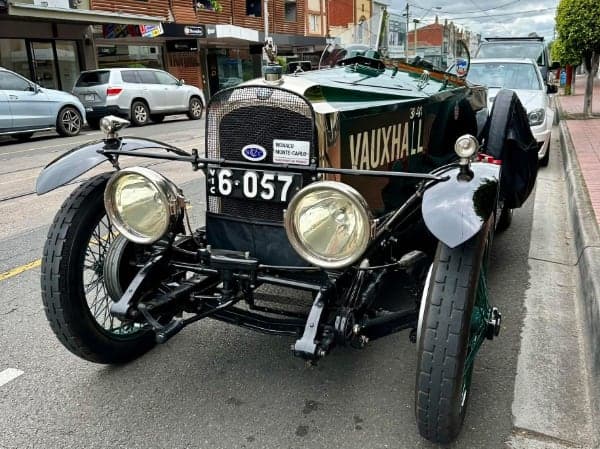
The Colour Wars: State Identity on Steel
If you’ve ever played the car-spotting game on a highway, you already understand the power of plate colour. Each state’s colour scheme is as much a part of its visual identity as its coat of arms.
New South Wales has long been the outlier — saffron yellow with black text, a bold scheme that stands apart from every other state. It’s the most instantly recognisable plate in the country, and the one that sparks the most debate.
Victoria went through a series of evolutions — from the original black on white to blue on white with rotating slogans: “The Garden State,” “On the Move,” “The Place to Be,” and more recently “Stay Alert Stay Alive.” Each slogan shift coincided with a subtle design refresh, though the fundamental palette has remained restrained and legible.
Queensland embraced maroon before cycling through several iterations. South Australia adopted an ochre-tinged palette that evokes the outback landscape. Western Australia moved from black-on-yellow to blue-on-white, while Tasmania has arguably the most scenic approach, incorporating imagery of the island state into special editions.
These aren’t just administrative decisions. Plate colour is soft infrastructure — it shapes how millions of people unconsciously perceive each state, every day, in traffic. It’s public design at a scale most graphic designers would envy.
The Heritage Renaissance
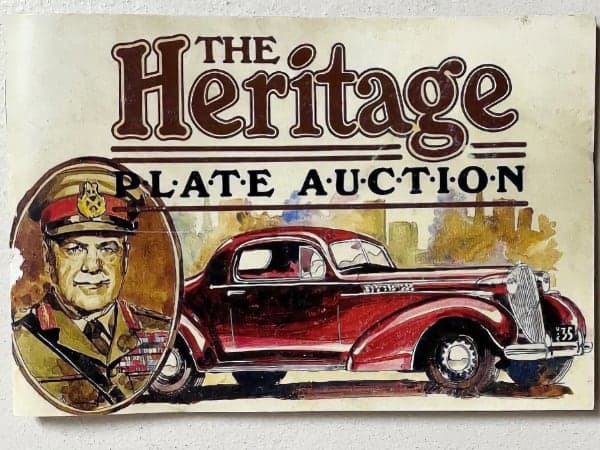
The most dramatic intersection of plates and art arrived in October 1984, when Victoria’s Road Traffic Authority held its inaugural Heritage Plate Auction. The concept was radical: reissue dormant plates from the original 1930s all-numeric series, handcrafted in black vitreous enamel to closely resemble the originals.
The production process remains extraordinary. Each heritage plate is individually embossed into heavy-gauge steel, then etched and coated with black and white vitreous enamel before being oven-baked to a high-gloss finish. Because they’re handcrafted, no two are exactly alike.
The plates arrive in a wooden presentation box with a certificate of authenticity. They are, in every meaningful sense, limited-edition art objects that happen to be road-legal.
The market agrees. At that inaugural auction, VIC 1 sold for $165,000 — more than double Melbourne’s median house price at the time. VIC 9 fetched $31,000, and the auction raised over $1 million in total, with proceeds directed toward road safety. By 2024, VIC 24 sold for $1.82 million. The six-digit plate “123-456” fetched $363,000, setting an Australian auction record for a six-digit combination. Only 285,000 heritage numbers were ever issued between 1932 and 1939, and no more will be created.
The Euro Influence and the Rise of Personal Style
The most significant design shift of the 2000s came from car culture itself. As European vehicles grew in popularity, the standard 372mm × 134mm plate looked increasingly awkward on cars designed for the elongated European format.
Enter the Euro plate: 520mm × 112mm, slimmer and longer, designed to sit flush in the recessed plate housings of BMWs, Mercedes, and Audis. What began as a practical fitment solution became an aesthetic statement.
States embraced the format enthusiastically. South Australia offers Euro plates through EzyPlates. Victoria sells them through VPlates in four premium colour options. NSW introduced its own Euro range in 2002 alongside Japanese-style JDM plates. Queensland followed with Euro Classic and Euro Theme options.
The proliferation of plate styles has turned what was once a standardised government-issued item into something closer to a fashion accessory. Today, you can choose from dozens of colour combinations, formats, and themes — from corporate plates that display your business name, to sporting team plates, to charity-branded editions, to fully custom combinations.
Typography: The Unsung Design Element
Here’s something most people never notice: number plate typography is its own design discipline. The standard Australian plate uses embossed dies that have evolved subtly over decades, balancing legibility at speed with aesthetic appeal.
The lettering must be readable from 20 metres — a legal requirement that constrains every typographic decision. Characters need to be distinguishable from each other at distance, which is why the letters I and O were historically excluded from standard series. The weight, spacing, and proportions of plate characters are the product of decades of refinement — a kind of vernacular typography that nobody designed in the traditional sense, but that everyone recognises instantly.
Heritage plates take this further. Their hand-embossed characters have an organic quality that machine-stamped plates can’t replicate — slightly uneven baselines, gentle variations in stroke width, the warmth of a human hand pressing metal. It’s the same quality that draws people to letterpress printing or hand-thrown ceramics.
Plates as Public Gallery
Step back and consider the full picture. Every day, millions of Australian vehicles carry small rectangular design objects through city streets and country highways. Some are standard issue — functional, unremarkable, doing their job. Others are carefully chosen expressions of identity, status, nostalgia, or humour.
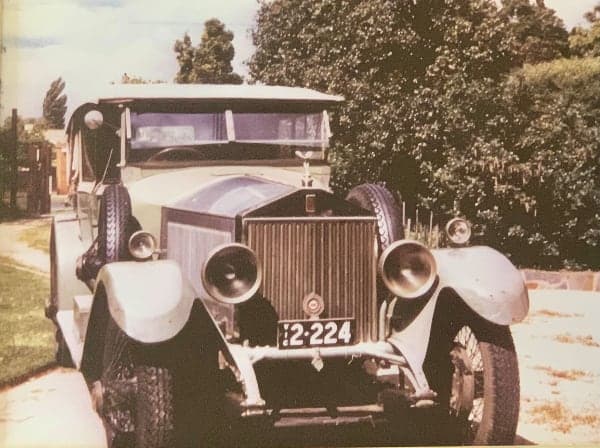
A heritage plate on a classic car at a Sunday morning car meet. A custom Euro plate on a pristine M3, perfectly flush with the rear diffuser. A bold yellow NSW plate, unmistakable in a Melbourne parking garage. A single-digit number on the back of a Rolls-Royce, saying everything by showing almost nothing.
These aren’t just registration numbers. They’re the country’s most ubiquitous and overlooked form of public art — mass-produced but individually chosen, government-regulated but personally expressive, functional but often beautiful.
Next time you’re stuck in traffic, look at the plate in front of you. Someone chose that. And behind that choice is 115 years of design history, state rivalry, manufacturing craft, and personal identity — all compressed onto a rectangle smaller than a laptop screen.
Thinking about what your plate says about you? Whether you’re buying or selling personalised plates, AusPlates is Australia’s free marketplace for custom number plates. List for free, browse plates from every state, and download our iOS app to take the marketplace with you.
Sources
• Heritage Only — The History of Victorian Heritage Plates
• Wikipedia — Vehicle registration plates of Australia
• VPlates — Heritage plate style details
• VPlates — Euro plate style details
• Carsales — Victorian number plate sells for $363,000
• EzyPlates SA — Euro plate dimensions and styles
• Personalised Plates Queensland — Product range
• Carify — Australian Number Plates Explained
• Wikipedia — Vehicle registration plates of New South Wales